
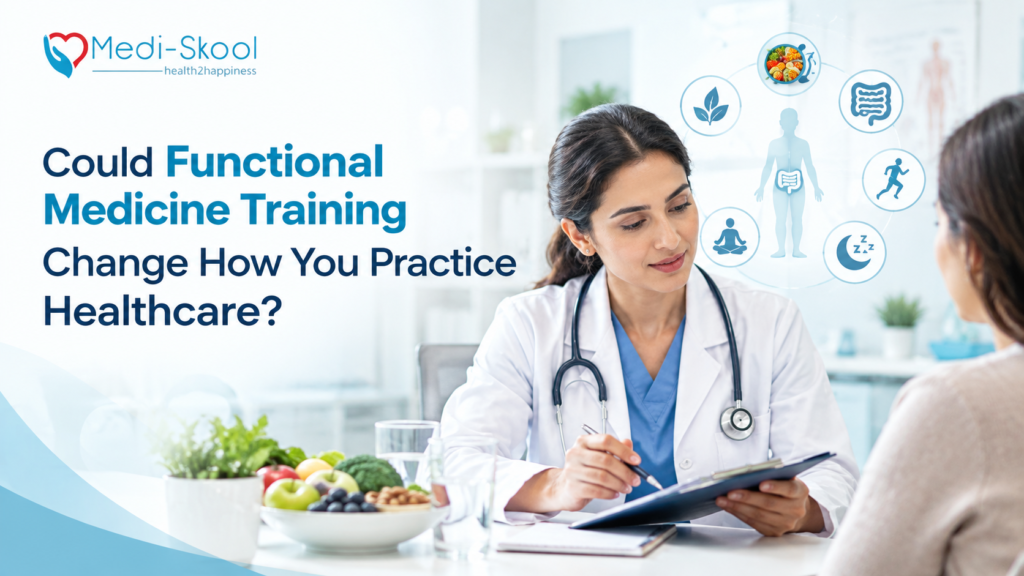
What if the symptoms you see every day are only part of the story? A patient may come to you with fatigue, digestive problems, weight changes, poor sleep, or recurring health concerns, but treating each symptom separately does not always explain why the problem keeps returning. This is why Functional Medicine training in Gurugram is gaining attention among healthcare professionals who want to understand patients from a broader, more personalised perspective.
But can Functional Medicine training really change the way you practice healthcare? Or is it simply another approach added to an already crowded healthcare system?
The answer depends on how you learn it and, more importantly, how you apply it.
Why Are Healthcare Professionals Looking Beyond Symptoms?
Modern healthcare has excellent tools for diagnosis and treatment. However, many healthcare professionals also encounter patients whose concerns are influenced by several factors at the same time.
For example, digestive health may be connected with nutrition, lifestyle and stress. Metabolic concerns may involve diet, sleep, activity and other underlying factors. Hormonal concerns may also appear alongside changes in weight, mood or energy.
This creates an important question:
Are we treating the symptom, or are we understanding the patient behind it?
Functional Medicine encourages professionals to look at the bigger clinical picture. Instead of focusing only on what is happening, it also asks why it may be happening.
That shift can influence how a healthcare professional takes a history, evaluates information and communicates with patients.
What Does Functional Medicine Training Actually Teach?
Functional Medicine is not simply about learning a list of supplements or alternative treatments.
A meaningful training programme should help healthcare professionals understand concepts such as patient assessment, nutrition, lifestyle factors, gut health, metabolic health, hormonal balance and the relationship between different systems of the body.
The goal is to develop clinical reasoning, not just memorisation.
You may start asking different questions:
- What could be contributing to this patient’s symptoms?
- Are there lifestyle factors that need attention?
- Is there a connection between the patient’s digestive and metabolic concerns?
- What information is missing from the current assessment?
- How can I explain the patient’s health concerns in a way they understand?
These questions can make patient consultations more detailed and personalised.
Can Functional Medicine Fit Into Conventional Healthcare?
This is one of the most important questions professionals should ask.
Functional Medicine should not be viewed as a replacement for appropriate conventional medical care. Instead, healthcare professionals can learn additional frameworks for understanding nutrition, lifestyle, root-cause factors and patient patterns while continuing to work within their professional scope.
The value lies in knowing when a broader assessment may be useful and when conventional investigation or treatment is necessary.
This balanced approach is particularly important when dealing with complex or chronic health concerns.
Why Does Practical Experience Matter?
Would you expect a healthcare professional to become confident simply by reading a few articles?
Probably not.
Healthcare requires application.
That is why practical case discussions and experienced mentorship can make a major difference in professional education. Working through patient scenarios helps learners move from theory to clinical thinking.
Medi-Skool’s approach combines structured education with practical learning across areas of Functional and Integrative Medicine. Its programmes cover topics including Functional Medicine, Gut Health & Microbiome, Diabetes Reversal, BHRT and other specialised areas.
The idea is simple: understanding a concept is useful, but knowing how to think through a real patient scenario is even more valuable.
Why Choose Medi-Skool?
With so many online healthcare courses available, another question naturally comes up:
What makes one training programme more useful than another?
Medi-Skool focuses on education designed for healthcare professionals who want to build knowledge in Functional and Integrative Medicine.
Experienced Faculty
Learning from experienced professionals can add context that textbooks cannot always provide.
Medi-Skool’s faculty and educational approach bring clinical experience into the learning process, helping professionals understand how concepts can relate to real patient situations.
Structured Learning
Instead of jumping between unrelated topics, structured training provides a clearer learning path.
Medi-Skool offers specialised programmes covering Functional Medicine, gut health, BHRT and other areas, allowing healthcare professionals to develop knowledge progressively.
Practical Case-Based Learning
Real patients do not always fit neatly into textbook categories.
Case discussions can help professionals understand how different symptoms, lifestyle factors and health patterns may interact.
Mentorship
Learning does not necessarily stop when a module ends.
Access to guidance and mentorship can help professionals clarify concepts and develop a more practical understanding of the subject.
Could Functional Medicine Training Change Your Patient Conversations?
Possibly one of the biggest changes is not what you prescribe but what you ask.
Instead of immediately focusing on one symptom, you may begin exploring nutrition, lifestyle, sleep, stress, digestive health and other relevant factors.
A patient who previously received a quick recommendation may now have a more detailed conversation about their overall health pattern.
That does not mean every patient needs an extensive Functional Medicine assessment.
It means you become better equipped to recognise when a broader conversation could be valuable.
Who Should Consider Functional Medicine Training?
Functional Medicine education may be worth considering if you are a healthcare professional who:
- Wants to understand chronic health concerns more comprehensively
- Is interested in personalised healthcare
- Wants to strengthen knowledge of nutrition and lifestyle factors
- Regularly works with patients dealing with complex symptoms
- Wants to explore Gut Health, BHRT or metabolic health
- Is interested in expanding professional knowledge beyond conventional symptom management
The important point is to choose training that matches your professional background, responsibilities and scope of practice.
Is Functional Medicine Training Worth It?
There is no universal answer.
If you are looking for a quick certificate without intending to apply the knowledge, probably not.
But if you want to improve how you assess patients, ask questions and understand connections between different health factors, structured training can be a worthwhile professional investment.
The real benefit may not be learning another healthcare terminology.
It may be learning to think differently about the patient sitting in front of you.
Final Thoughts
Healthcare is constantly evolving. Patients are also becoming more informed and increasingly asking questions about nutrition, gut health, hormones, lifestyle and Functional Medicine training in Gurugram personalised care.
For healthcare professionals, this creates an opportunity to expand their knowledge while maintaining evidence-based clinical judgment.
Functional Medicine training can introduce a broader framework for looking at health one that considers the patient as a whole rather than viewing every symptom in isolation.
And perhaps the most important question is not:
Can Functional Medicine change how I practice?
It is:
Could understanding the bigger picture help me ask better questions and have better conversations with my patients?
For professionals who want to explore that approach, structured education, experienced faculty, practical learning and mentorship can provide a stronger starting point than trying to learn everything independently.
FAQs
1. Who can study Functional Medicine?
Healthcare professionals interested in personalised and integrative care.
2. What does Functional Medicine training cover?
It can cover patient assessment, nutrition, lifestyle, gut health, metabolic health and more.
3. Is Functional Medicine a replacement for conventional medicine?
No. It can complement appropriate conventional healthcare within professional scope.
4. Does Medi-Skool offer practical learning?
Yes, its programmes include practical and case-based learning.
5. Why choose Medi-Skool?
For structured courses, experienced faculty, practical learning and mentorship.