A patient comes to you with bloating, constipation, acidity, food sensitivities and constant fatigue.
They have already tried different diets. They may have taken probiotics. They may even have seen more than one doctor.
Still, the problem keeps coming back.
What do you do when the usual approach does not seem to explain the complete picture?
This is one reason gut health has become an important area of interest for healthcare professionals. The gut is not only responsible for digestion. It is closely connected with nutrition, the microbiome, immune function, metabolism and several aspects of overall health.
But does that mean every healthcare professional needs to study gut health?
Not necessarily.
The better question is:
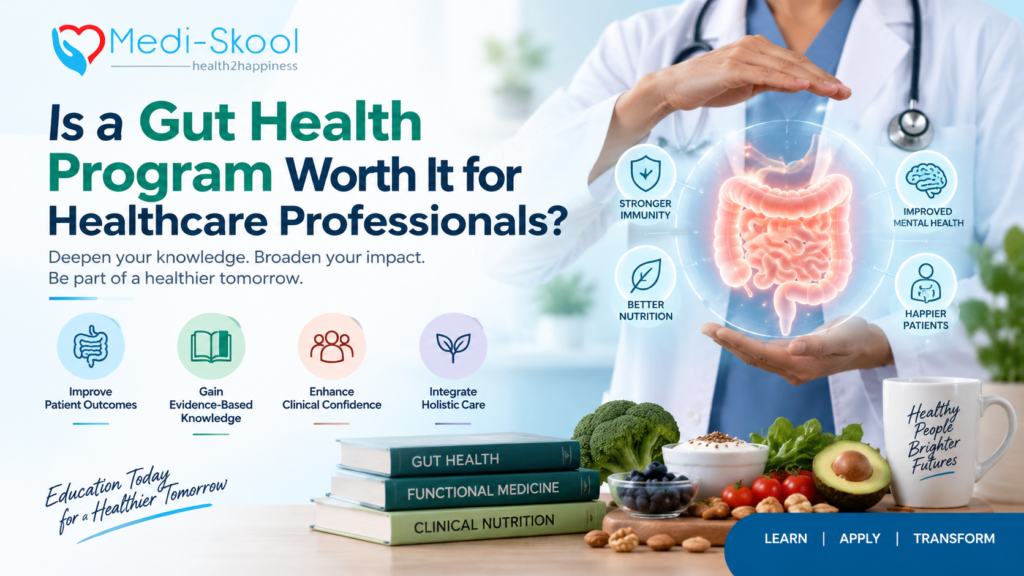
Can a structured gut-health programme give you knowledge that you can actually use with your patients?
For professionals looking for the Best Gut Health Program in India, the answer should depend on the quality of the training, clinical experience behind it, practical learning, mentorship and how well the programme connects gut health with the wider picture of patient care.
Why Are Healthcare Professionals Paying More Attention to Gut Health?
There was a time when gut health was mainly discussed in terms of digestion.
Bloating meant bloating.
Constipation meant constipation.
Acidity meant acidity.
Today, healthcare professionals are increasingly interested in the relationship between the digestive system and other areas of health.
The gut microbiome contains a large community of microorganisms. These microorganisms are involved in digestion, nutrient processing and immune-related functions. Medi-Skool’s gut-health programme specifically focuses on the gut microbiome and its relationship with broader health.
That does not mean every health problem comes from the gut.
It means that, for the right patient, gut health may be one important part of the clinical picture.
What Could You Miss Without Proper Gut-Health Knowledge?
Imagine a patient with recurring digestive complaints.
You could simply discuss their diet.
But what if their sleep is poor?
What if they are under constant stress?
What if they have a long history of medication use?
What if their symptoms started after an infection?
What if they have metabolic problems as well?
What if they have already tried several restrictive diets?
Suddenly, the case becomes more complicated.
This is where structured education can help.
Instead of memorising a list of “good” and “bad” foods, healthcare professionals can learn to look at the patient’s history, lifestyle, symptoms and relevant clinical information together.
Is Gut Health Really Just About Diet?
This is one of the biggest misconceptions.
Food is certainly important.
But it is not the whole story.
Medi-Skool’s 6R framework includes Remove, Replace, Reinoculate, Repair, Rebalance and Reconnect. The framework brings together dietary factors, digestive support, microbiome balance, gut-lining support and lifestyle considerations such as sleep, stress and movement.
That broader view can be useful for healthcare professionals because it encourages them to ask:
What else might be affecting this patient’s gut?
Rather than:
“Which food should I remove?”
That difference may sound small, but it can change the way a case is approached.
What Is the 6R Gut Healing Framework?
Medi-Skool uses the 6R approach as a structured framework for understanding gut health.
1. Remove
The first step looks at factors that may be contributing to gut irritation or dysfunction.
Depending on the patient, this may involve dietary triggers, pathogens, certain medications, environmental factors or lifestyle-related issues.
The key point is that removal should be based on the individual—not a blanket list given to everyone.
2. Replace
Once relevant problems have been identified, the next question is whether digestion and nutrient breakdown need additional support.
The Replace stage considers factors involved in digestion and nutrient absorption.
3. Reinoculate
The gut is an ecosystem.
This stage focuses on supporting a healthier microbial environment through appropriate dietary strategies, prebiotic fibre, probiotic foods or other suitable approaches.
Again, the objective is not simply to take as many probiotics as possible.
4. Repair
The Repair stage focuses on supporting the gut lining and addressing factors associated with ongoing inflammation.
Medi-Skool’s programme discusses nutritional and lifestyle strategies as part of this process.
5. Rebalance
This is where the programme moves beyond food.
Sleep, stress, movement and daily routines can all be relevant to digestive health. Medi-Skool specifically includes these lifestyle factors within the Rebalance stage.
6. Reconnect
The final stage focuses on making healthier habits sustainable.
Because what is the point of following a gut-health plan for a few weeks if the patient immediately returns to the same routine?
Reconnect is about helping patients build a more sustainable relationship with food, lifestyle and their own health signals.
Why Is This Useful for Healthcare Professionals?
A framework gives you something to organise your thinking around.
Without a structure, gut-health education can become a confusing collection of probiotics, supplements, elimination diets and testing options.
With a framework, you can start asking more practical questions.
What needs to be addressed first?
What information is missing?
Is the patient’s diet really the main issue?
Does the patient need further medical evaluation?
Which lifestyle factors need attention?
What should be monitored?
And perhaps most importantly:
What should I not assume?
That last question is important because good healthcare is not about finding a gut-related explanation for every symptom.
Are Real Cases More Valuable Than Theory?
They can be.
Reading about the microbiome is relatively easy.
Working through a patient with multiple symptoms is much harder.
A real case may involve digestive complaints alongside diabetes, autoimmune concerns, fatigue, hormonal problems, poor sleep or medication use.
Suddenly, there is no simple checklist.
You have to think about priorities.
Medi-Skool’s broader educational model includes real-life case studies, live clinical case discussions, structured modules, digital resources and guided mentorship.
This practical component is particularly relevant for healthcare professionals who want to understand how gut-health concepts may translate into patient care.
Why Does Clinical Experience Matter?
Anyone can write a list of gut-health tips online.
Professional education is different.
The person teaching you should understand what happens when a patient does not fit neatly into a textbook example.
Medi-Skool identifies Dr. Priti Nanda Sibal as its founder and CEO. The organisation states that she has an MBBS degree, a fellowship in functional medicine from George Washington University in the USA, and more than 30 years of healthcare experience, with areas including gut health, diabetes management, autoimmunity and obesity reversal.
Her own clinical experience is also presented as a major reason for developing a functional medicine approach, particularly after working with complex patients whose symptoms could not always be understood through a single diagnosis.
For a healthcare professional, that experience adds context to the education.
Why Choose Medi-Skool for Gut Health Education?
Medi-Skool’s main strength is that gut health is not taught completely in isolation.
Its wider learning ecosystem includes Functional Medicine, Gut Health & Microbiome, BHRT, diabetes reversal, nutrition and heart-health programmes.
That matters because gut health often intersects with other areas of healthcare.
A patient with digestive symptoms may also have metabolic concerns.
Another may have hormonal issues.
Someone else may be dealing with chronic inflammation or lifestyle-related problems.
Understanding these connections can help healthcare professionals look at the patient more completely.
Medi-Skool also highlights:
- Structured learning modules
- Experienced faculty
- Real-life case studies
- Live sessions
- Digital learning resources
- Expert-led training
- Certification
- Ongoing mentorship
The 6R Gut Health Mastery Programme provides a specific framework for learning about gut health, including the microbiome, digestion, gut-lining support and lifestyle balance.
Is a Gut Health Programme Worth the Investment?
That depends on what you expect from it.
If you want a quick certificate, a programme may not provide much long-term value.
But if you regularly work with patients experiencing digestive problems and want to understand the subject more deeply, structured education can be useful.
It may help you become more comfortable discussing:
- Digestive symptoms
- Gut microbiome
- Food sensitivities
- Nutrition
- Lifestyle factors
- Stress and sleep
- Digestive support
- Gut-health assessment
- Metabolic and gut connections
- Personalised patient education
The value is not simply knowing more.
It is knowing how to use that knowledge appropriately.
What Should You Check Before Joining a Gut Health Course?
Don’t choose a programme simply because it calls itself “advanced.”
Look at what is actually being taught.
Check the Faculty
Do the instructors have relevant healthcare and clinical experience?
Look at the Curriculum
Does it cover the microbiome, digestion, nutrition, lifestyle and clinical assessment?
Ask About Case-Based Learning
Will you work through actual or realistic patient cases?
Look for Mentorship
Can you ask questions and learn from experienced professionals?
Understand the Certification
What exactly does the certificate represent?
Consider Your Scope of Practice
Additional training can expand your knowledge, but it does not automatically change your professional or legal scope.
These points are far more important than simply choosing the course with the longest list of modules.
Could Gut Health Knowledge Change Your Consultation?
It might.
You may still begin with the patient’s primary complaint.
But your conversation could become more detailed.
Instead of only asking
What are you eating?
you might ask:
What happens after you eat?
Instead of:
Are you stressed?”
you might explore how stress is affecting sleep, eating patterns and daily routine.
Instead of immediately recommending another supplement, you might first ask:
Do we know why this patient needs it?
That shift from giving quick answers to asking better question is one of the most useful things professional education can offer.
Is Gut Health a Career Opportunity?
It can certainly become an area of professional development.
Healthcare professionals working in nutrition, functional medicine, preventive healthcare, lifestyle medicine or related areas may find gut-health knowledge useful.
But it is important to keep expectations realistic.
No programme can honestly guarantee a specific income, number of patients or career outcome.
Professional growth depends on your existing qualifications, experience, communication, reputation and how responsibly you apply what you learn.
A gut-health programme should be viewed as an opportunity to develop knowledge and clinical understanding, not as a shortcut to professional success.
Final Thoughts
So, is a gut health programme worth it for healthcare professionals?
For someone who regularly sees patients with digestive concerns, wants to understand the microbiome better, or is interested in a broader functional medicine approach, it can be a valuable area of further education.
But choose carefully.
Look for experienced faculty.
Look for real cases.
Look for a structured framework.
Look for mentorship.
And look for education that teaches you to think—not simply follow protocols.
For professionals comparing options for the Best Gut Health Program in India, Medi-Skool stands out through its combination of the 6R framework, functional medicine perspective, practical case learning, experienced faculty and mentorship.
Ultimately, the purpose of gut-health education should not be to make every patient follow the same plan.
It should help you understand which questions to ask, what information matters, when further assessment is needed, and how gut health fits into the patient’s bigger health picture.
And that is where good education becomes genuinely useful.
FAQs
1. Is gut health training useful for doctors?
Yes, it can broaden knowledge of digestive and microbiome-related health.
2. What does the 6R framework include?
Remove, Replace, Reinoculate, Repair, Rebalance and Reconnect.
3. Does the programme include practical cases?
Medi-Skool highlights real-life cases and live clinical discussions.
4. Who teaches Medi-Skool’s gut-health programme?
The programme is led by experienced functional medicine professionals including Dr. Priti Nanda Sibal.
5. Why choose Medi-Skool?
It combines structured learning, clinical cases, expert guidance and mentorship.