
The demand for Functional Medicine is growing rapidly as more patients search for healthcare solutions that focus on personalization, prevention and root cause healing. From diabetes and hormonal imbalances to gut disorders, chronic inflammation and metabolic dysfunction, patients today want more than temporary symptom relief.
As a result, healthcare professionals across India including doctors, nutritionists, health coaches and integrative practitioners are actively exploring Functional Medicine education.
One important question often comes up during this journey:
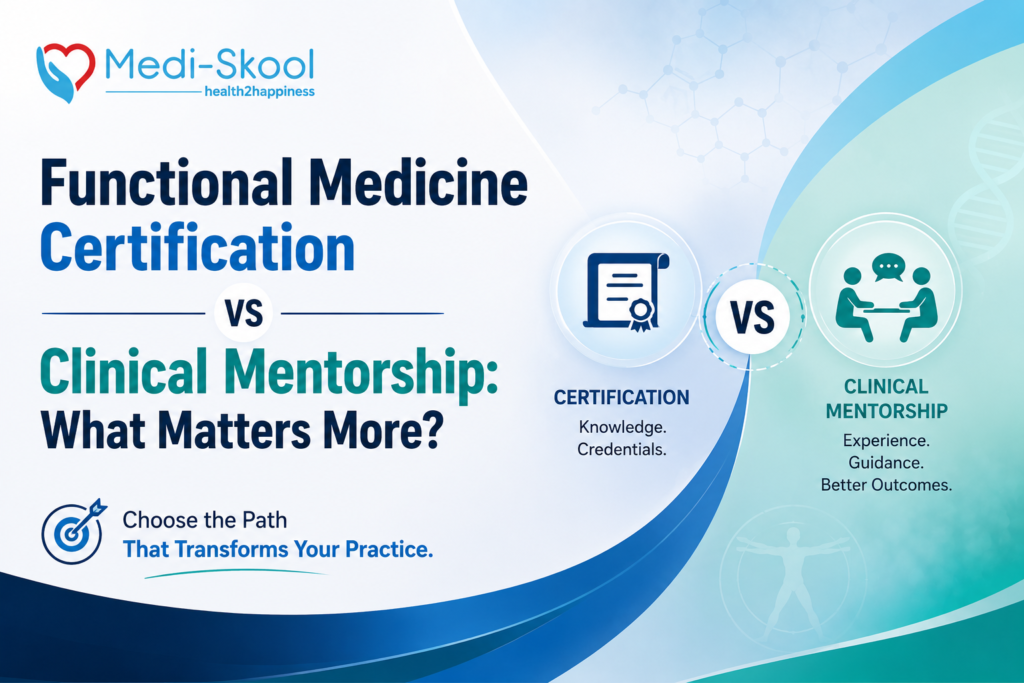
Should you pursue a Functional Medicine certification or invest in clinical mentorship?
Both have value. However, understanding the difference between theoretical education and practical clinical training is essential for practitioners who want long term success in Functional Medicine.
Understanding Functional Medicine Certification
A Functional Medicine certification program is designed to provide structured theoretical education. These programs usually focus on:
Functional Medicine principles
Systems biology
Nutrition and lifestyle medicine
Gut health and inflammation
Hormonal and metabolic health
Chronic disease mechanisms
Certification programs play an important role because they help practitioners build foundational knowledge and understand the philosophy behind root cause medicine.
For many healthcare professionals, certifications are the first step toward entering the Functional Medicine space. Online courses, workshops and Functional Medicine courses in Gurugram have made this education more accessible than ever before.
However, theoretical understanding alone may not always prepare practitioners for the complexity of real clinical practice.
The Gap Between Learning and Clinical Application
One of the biggest challenges in healthcare education is the gap between theory and implementation.
A practitioner may understand Functional Medicine concepts academically, yet still feel uncertain while managing real patients with chronic disease.
Many practitioners struggle with:
Complex symptom patterns
Overlapping health conditions
Advanced lab interpretation
Personalized treatment planning
Treatment sequencing
Patient compliance challenges
Long standing chronic illness cases
Reading about Functional Medicine is very different from applying it in a busy clinical environment.
This is where clinical mentorship becomes incredibly valuable.
What Is Clinical Mentorship in Functional Medicine?
Clinical mentorship is a practical, experience-driven learning model where practitioners learn directly from experienced clinicians managing real patient cases.
Instead of simply studying concepts, practitioners learn:
How to think clinically
How to investigate root causes
How to prioritize interventions
How to interpret patterns
How to make better clinical decisions
Under experienced mentors like Dr. Priti Nanda Sibal, students are exposed to the real world application of Functional Medicine within an active clinical setting.
This type of mentorship often includes:
Live case discussions
Root cause analysis
Advanced lab interpretation
Personalized protocol design
Chronic disease management
Clinical reasoning frameworks
Functional Medicine implementation strategies
Rather than memorizing protocols, practitioners begin developing true clinical thinking skills.
Why Clinical Mentorship Builds Greater Confidence
Confidence in Functional Medicine does not come from certificates alone.
It develops through repeated exposure to real patient scenarios.
Many healthcare professionals complete certification programs but still hesitate when handling difficult cases independently. They may understand the science but feel unsure about:
Which intervention should come first
How to identify hidden root causes
How to sequence protocols correctly
When to adjust treatment plans
How different body systems influence each other
Clinical mentorship bridges this gap between knowledge and confidence.
By observing experienced Functional Medicine clinicians manage complex chronic diseases, practitioners start understanding the decision making process behind successful treatment outcomes.
This type of practical learning improves both clinical confidence and patient care results.
Why Real Clinical Exposure Matters
No two patients are exactly alike.
Two individuals with the same diagnosis may require completely different treatment approaches depending on:
Stress levels
Gut health
Sleep quality
Nutrient deficiencies
Environmental exposures
Hormonal balance
Metabolic health
Lifestyle habits
This level of complexity cannot always be understood through theory alone.
Clinical mentorship exposes practitioners to real world cases involving:
Autoimmune conditions
Hormonal disorders
Gut dysfunction
Insulin resistance
Fatty liver disease
Chronic fatigue
Mitochondrial dysfunction
Diabetes reversal approaches
These experiences help practitioners develop stronger clinical reasoning and more personalized treatment strategies.
Certification Gives Knowledge. Mentorship Builds Clinical Wisdom.
Both certification and mentorship serve important purposes in Functional Medicine education.
Certification helps practitioners:
Learn foundational concepts
Understand Functional Medicine principles
Build structured theoretical knowledge
Gain educational credibility
Clinical mentorship helps practitioners:
Apply knowledge confidently
Improve clinical reasoning
Analyze complex cases
Develop root cause thinking
Create personalized treatment plans
Make better clinical decisions
In many cases, mentorship becomes the missing link that transforms education into real clinical expertise.
Why More Practitioners Are Choosing Mentorship Based Learning
Healthcare professionals today want more than passive learning and prerecorded lectures.
They want:
Practical implementation
Interactive discussions
Real patient analysis
Personalized guidance
Clinical confidence
This is why smaller mentorship-focused Functional Medicine courses in Gurugram are attracting increasing interest from practitioners who want hands on learning experiences.
Under experienced mentors like Dr. Priti Nanda Sibal, practitioners gain exposure to:
Live clinical discussions
India specific patient cases
Advanced Functional Medicine applications
Root cause treatment strategies
Practical implementation frameworks
This approach helps practitioners move beyond textbook knowledge and understand how Functional Medicine truly works in everyday clinical practice.
The Future of Functional Medicine Education
Functional Medicine is transforming the future of healthcare by focusing on:
Prevention
Personalization
Systems biology
Lifestyle medicine
Root cause healing
As chronic diseases continue to rise globally, practitioners who develop advanced Functional Medicine skills will be better equipped to deliver meaningful long term patient outcomes.
Certification programs provide an important educational foundation.
But clinical mentorship often provides the practical experience required to become a confident and effective Functional Medicine practitioner.
For healthcare professionals who genuinely want to improve clinical decision making, solve complex chronic disease cases and elevate patient care, mentorship can offer significantly greater long-term value than theoretical learning alone.
FAQs
1. What is the difference between Functional Medicine certification and clinical mentorship?
Functional Medicine certification focuses mainly on theoretical education, while clinical mentorship emphasizes practical patient care, live case discussions, advanced lab interpretation and real world clinical decision making.
2. Is certification enough to practice Functional Medicine confidently?
Certification provides foundational knowledge, but many practitioners benefit from mentorship to develop practical implementation skills, clinical reasoning and confidence in managing complex patient cases.
3. Why is mentorship important in Functional Medicine?
Mentorship helps practitioners understand root cause analysis, treatment prioritization, advanced lab interpretation and personalized patient management in real clinical settings.
4. Who can join Functional Medicine courses in Gurugram?
Doctors, nutritionists, wellness practitioners, health coaches, integrative clinicians, and healthcare professionals interested in root cause medicine can benefit from these programs.
5. How does Dr. Priti Nanda Sibal’s mentorship help practitioners?
Dr. Priti Nanda Sibal focuses on practical Functional Medicine implementation, live clinical case discussions, advanced decision making frameworks and root cause treatment strategies that help practitioners improve patient outcomes.